


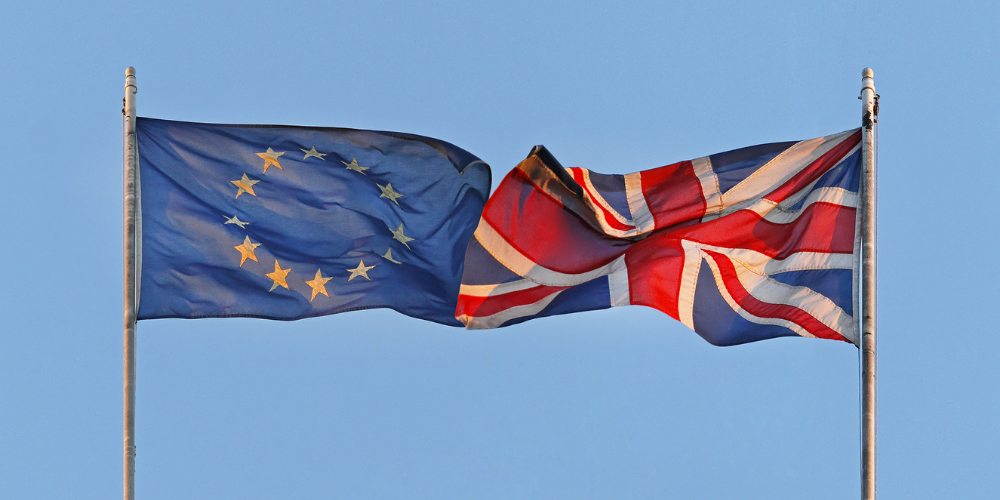
Ten years later, the world is a different place, with geopolitics back at the centre. International relations and the global economy have undergone substantial changes since the 2016 Brexit referendum. The past decade has been marked by events of major global significance, including the pandemic, Russia’s war against Ukraine, growing rivalry between the United States and China and, more recently, the war in the Middle East. At the same time, the United States has undergone a strategic and protectionist shift in its policy, calling into question the transatlantic relationship and undermining the UK’s special relationship with the United States. The global technological race has also intensified, particularly in the pursuit of leadership in artificial intelligence and digital infrastructure.
The result is a more contested and complex global economy, characterized by the breakdown of the rules-based international order and the growing use by states of trade, financial, technological, energy and even military instruments to defend their interests, a dynamic that we at Equipo Económico (Ee) have come to refer to as geopolitical statecraft.
In this new global context, the stability of relations with reliable partners has therefore acquired an additional dimension. Its economic significance now extends beyond trade and investment to encompass energy and supply chain security, access to raw materials and strategic technologies, and defense.
Brexit has imposed an additional structural drag. The United Kingdom has faced a particularly challenging decade, further weighed down by the structural consequences of its departure from the European Union. Brexit introduced new trade, regulatory and administrative barriers with its main economic partner, increased uncertainty surrounding investment decisions and reduced the integration of the British economy with the European market. Various estimates suggest that these effects may have reduced UK GDP by between 6% and 8% by 2025 compared with a scenario in which the country had remained in the EU, while also generating additional inflationary pressures.
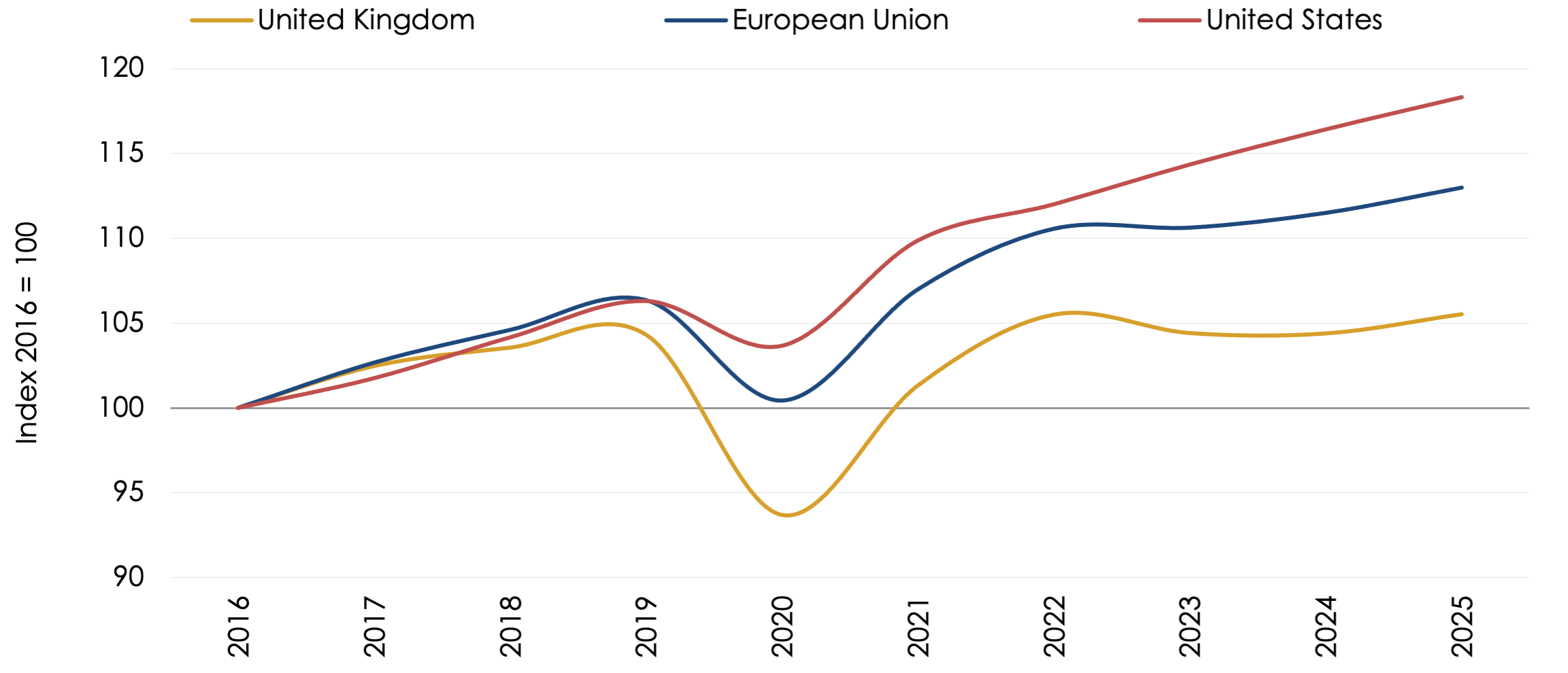
A comparison of economic developments since 2016, when some of the main effects of Brexit began to emerge in the United Kingdom following the referendum, points to weaker relative economic performance. UK real GDP per capita grew by a cumulative 5.5% between 2016 and 2025 as shown in Graph 1, compared with 13% in the EU and 18.3% in the US. By contrast, prices rose more sharply in the UK (37.1%) than in the US (34.3%) and the EU (33%) over the same period. Furthermore, following its depreciation after the referendum, the pound sterling has generally traded around €1.15 per pound, below the approximately €1.30 per pound seen in the months leading up to the 2016 vote.
GRAPH 1. THE UK’S GDP PER CAPITA GROWTH COMPARED WITH THE U.S.A AND THE E.U FOR THE PERIOD BETWEEN 2016 AND 2025
 Source: World Bank, Equipo Económico (Ee).
Europe also needs fundamental reforms to restore its competitiveness, as the Draghi and Letta reports rightly highlighted, together with a much stronger and more integrated approach to defense, strengthening Europe’s strategic autonomy and its capacity to act in a more uncertain and increasingly contested geopolitical environment. Brexit represented not only a significant loss of economic weight for the EU, with the UK accounting for around 16% of EU GDP in 2016 and being its second-largest economy after Germany, but also the loss of a strong voice in favor of a more competitive, open and reform-oriented Europe. Its return to the European debate could therefore be beneficial not only for Britain, but for Europe as a whole.
On the political front, the UK has experienced a period of considerable institutional instability, with seven prime ministers over the past decade. Yet the UK is not alone in facing political turbulence. The EU itself is navigating an increasingly challenging environment, with more extreme and Eurosceptic forces gaining ground amid an intense electoral calendar across major member states. In too many cases, this is accompanied by populist economic narratives that appear increasingly detached from the reality of public finances, echoes of the political discourse that helped persuade British voters to choose Brexit.
Consequently, the UK has consistently recorded in recent years a larger fiscal deficit as a percentage of GDP than the EU average, reaching 5.3% of GDP in 2025. Over the same period, British public debt increased by 14.8 percentage points from its 2016 level, reaching 102.1% of GDP in 2025. Against this backdrop, the yield on the UK’s 10-year government bond stands at 5.4%, above those of its US (5.1%), Italian (4.6%) and Spanish (4.1%) counterparts. By contrast, in 2016, the UK’s 10-year government bond yield was lower than those of Italy and Spain. Concerns over public finances are not, however, confined to the UK. Within the EU, these have increasingly centred on France, where fiscal imbalances and questions over the sustainability of public finances have put renewed pressure on French government bonds (4.9%).
A renewed rapprochement over the past year, ahead of the 20 November summit. In a clear response to the consequences of Brexit and the challenges posed by the global geopolitical landscape, the EU and the UK have begun to move noticeably closer together. In May 2025, the first EU–UK summit since Brexit took place, marking the beginning of a new phase of cooperation, particularly in security and defense. Since then, further progress has been made in negotiations on agri-food trade, emissions trading, energy security and youth and student mobility.
A further significant step has recently been taken at the political level. Newly appointed British Prime Minister Andy Burnham has stated that the United Kingdom needs to reassess its relationship with the EU, arguing that the current framework is insufficient. For now, his approach does not involve reopening the politically divisive debate over EU membership, but exploring different arrangements to redefine the country’s ties with the bloc and deepen cooperation in key areas. This marks a departure from Labour’s previous red lines, including its opposition to a customs union with the EU, and signals a willingness to consider a significantly closer long-term relationship with Europe. The second EU-UK Summit, to be held in Brussels on 20 November, will mark further progress in this direction.
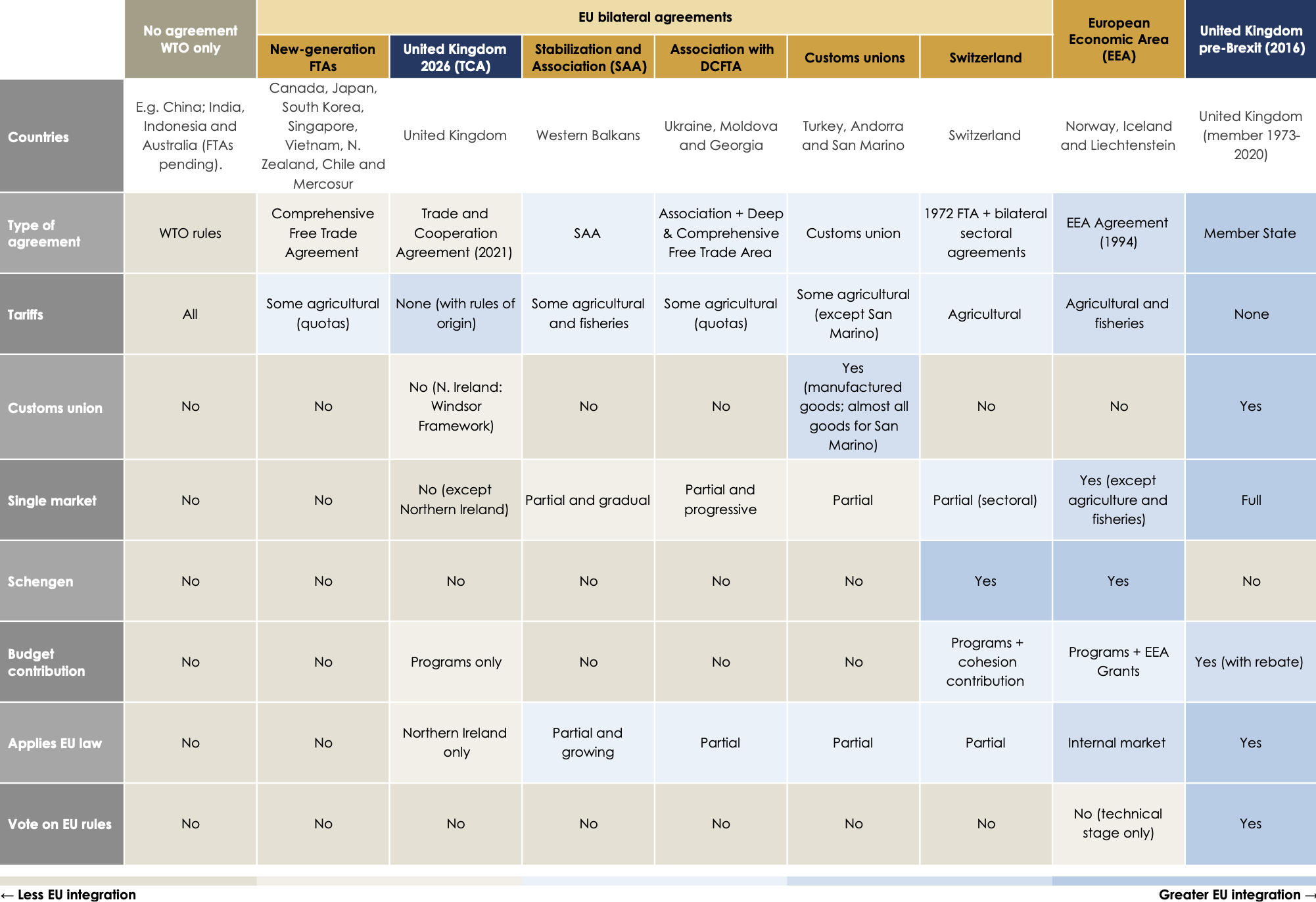
What new scenarios could emerge? Between the current framework governing UK–EU relations in 2026 and the arrangements that existed before Brexit in 2016, there are several degrees of integration. To illustrate these potential models, Table 1 below presents a selection of the different levels of integration that the EU maintains with third countries with which it has developed particularly close and formalized economic ties, ordered from lower to higher levels of integration from left to right.
TABLE 1. THE UK’S CURRENT POSITION AND POTENTIAL MODELS FOR ITS FUTURE RELATIONSHIP WITH THE EU BASED ON EXISTING ARRANGEMENTS WITH THIRD COUNTRIES.
 Source: Equipo Económico (Ee).
Notwithstanding recent progress, the starting point is the EU–UK Trade and Cooperation Agreement, in force since 2021, which allows trade in goods without tariffs or quotas, if rules of origin are met. However, the agreement leaves the UK outside both the customs union and the single market, thereby maintaining customs procedures and other regulatory barriers that did not exist before Brexit.
Beyond the current framework, several models of closer integration could be considered. A customs union, similar to the EU’s arrangement with Turkey, would remove barriers to goods trade, but would also require the UK to align part of its trade policy and external tariffs with those of the EU. A relationship closer to the Swiss model, meanwhile, would allow for deeper and more selective sectoral integration without requiring a new referendum. This model also bears certain similarities to the current approach to negotiations between the two sides. By contrast, a model based on the European Economic Area, such as that of Norway, would entail a much higher degree of integration and require the UK to accept many of the rights and obligations associated with the single market.
Arrangements associated with EU candidate countries appear less relevant unless the UK were to express a willingness to consider rejoining the Union, given the fundamentally different circumstances involved.
Beyond the existing models of EU–third country relations set out in table 1, the EU’s recent proposal to develop an “associate membership” for Canada could also point towards a new model of relations with countries outside the Union, a second orbit around the European project, based on deeper and more selective integration in areas such as trade, investment, energy, technology, research and defense, without full EU membership. If this model takes shape, it could potentially offer a framework for a future UK-EU relationship as well: closer and more strategic than the current post-Brexit arrangements, while stopping short of EU membership.
In an increasingly turbulent and fragmented world, marked by competition between major blocs and the strategic shift in US policy, including its declining willingness to act as Europe’s preferred ally in key areas such as defense, strengthening cooperation between the UK and the EU is becoming increasingly important. Although a return to the EU appears unrealistic in the short term, the rapprochement initiated in 2025 opens the door to progressively closer cooperation across different sectors, with both parties having strong incentives to deepen their ties.
José María Romero Vera
Director for Economic analysis and International affairs, Equipo Económico (Ee).
Jorge Vindel González.
Senior Economic Analyst – Economic analysis and International affairs, Equipo Económico (Ee)


