


The role of Big Tech in the new global power landscape: “G20 Economic Titans”
Large capital flows into big technology companies underline their growing weight in the global economy. Anthropic, the AI developer whose flagship model is Claude, plans to go public on November 19 in what is expected to be one of the largest IPOs in history, following SpaceX’s IPO earlier this year. OpenAI could follow suit in 2027. These IPOs reflect, on the one hand, the sector’s strong ability to attract capital and the expectations placed on AI development, and, on the other, the growing prominence of large technology corporations in the global economy and in areas such as defense and national security.
At the same time, the financing needs of these companies add to those of governments already carrying record levels of debt, intensifying competition for capital in a context of higher interest rates driven by monetary tightening in response to inflationary pressures. This greater demand for funds reinforces the upward pressure on the returns investors require, which have already been rising.
The technology race is a central dimension of geoeconomic confrontation. This mobilization of capital is taking place amid a breakdown of the international order and a growing primacy of power over rules, which at Equipo Económico we call geopolitical statecraft. States increasingly resort to economic, financial, technological, energy and even military instruments to defend their strategic interests. The race for technological leadership occupies a central position in this competition, especially in the rivalry between the US and China, as it determines who develops and controls the capabilities essential to economic, industrial and military leadership. Access to technology, energy and financing thus becomes a strategic priority shared by governments and companies.
We illustrate the growing weight of corporations on the map of global power through the definition of the “G20 Economic Titans.” Large technology and digital corporations are acquiring an economic and geopolitical relevance that goes beyond their business activity. Today we share an updated version of our map that brings together the world’s twenty largest economic actors, including states and companies, measured by their GDP and market capitalization, respectively.
The United States and China lead the group, with estimated 2026 GDP of $32.6 trillion and $21.5 trillion, respectively. They are followed by Germany ($5.5 trillion), slightly above Apple’s market capitalization ($5.2 trillion), which exceeds the GDP of Japan and the United Kingdom. The market capitalizations of Nvidia, Microsoft and Alphabet exceed France’s GDP, while Amazon ranks ahead of Russia, Italy and Brazil. Spain, with a GDP of $2.1 trillion, ranks 21st and appears as a guest participant, analogous to its status as a permanent guest within the group of nations that makes up the G20.
AI is boosting economic activity and offers opportunities to raise productivity. The development of AI already has an observable positive impact on the real economy through investment and international trade. This impact is contributing to the resilience the global economy has shown in 2026. However, its effects are unevenly distributed, with a greater incidence in economies such as the US or Asian hardware-supplying countries. In the medium and long term, the challenge will be to turn this investment effort into a sustained improvement in productivity. Doubts persist, however, about when those gains will materialize and how large they will be, along with uncertainty about the impact on employment and the implications for cybersecurity.
In this context, the B20, the G20’s business dialogue group, has presented its priorities for continued growth. It did so at its meeting held November 9–11 in Washington, organized by the U.S. Chamber of Commerce. Its conclusions identify economic growth, innovation, trade and energy as the four main areas for action. The B20 agenda thus highlights that the main challenge is not simply to mobilize the capital needed to finance the technological revolution, but also to create the conditions for this investment effort to translate into potential growth.
To this end, it calls for a more predictable regulatory environment, greater availability of energy and infrastructure, a workforce prepared for technological change, and an open trading system that facilitates the spread of investment and innovation. This must be accompanied by greater fiscal discipline in the face of competition for capital and rising private financing costs. Ultimately, the ability to turn the current AI investment race into sustained productivity gains will depend as much on technology and capital as on the economic and institutional framework that enables their deployment.
Ee CHART OF THE MONTH. COMBINED RANKING OF THE WORLD’S 20 LARGEST ECONOMIC
ACTORS BY COUNTRIES’ GDP AND COMPANIES’ MARKET CAPITALIZATION. TRILLIONS OF U.S. DOLLARS.
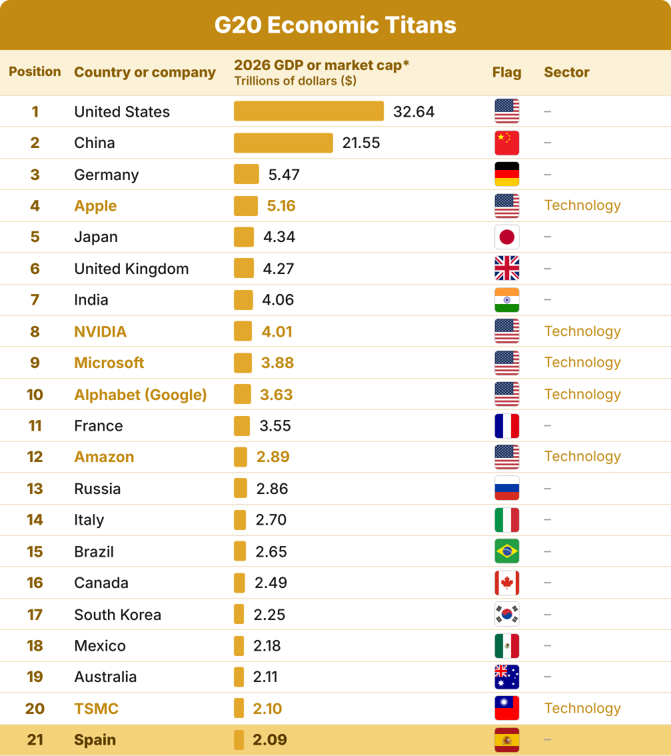
(*) IMF projections for 2026 GDP and market capitalization as of November 12, 2026.
Source: International Monetary Fund (IMF) and CompaniesMarketCap, Equipo Económico (Ee).
Director, Economic analysis and International affairs
Senior Analyst I Economic analysis and International affairs

